CRM Integration
Send website leads, customer details and follow-up information from forms and orders into your CRM.

When orders, customer records, inventory, payments and form submissions are spread across disconnected tools, teams lose valuable time moving information manually. BlueBit designs practical API integrations that connect WordPress and WooCommerce with CRM, ERP, accounting, messaging and third-party services. We focus on reliable data exchange, clear ownership of information and workflows your business can maintain as it grows.
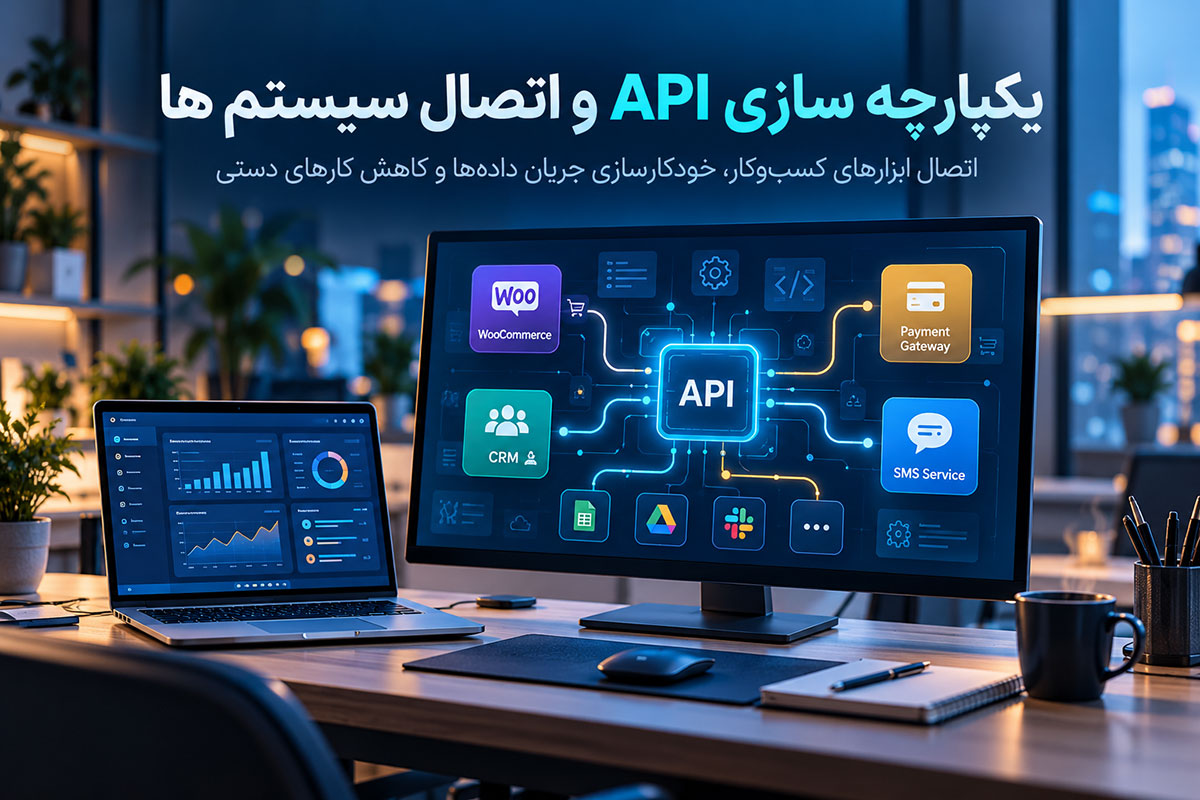
For many businesses, the main issue is not the website itself. Problems emerge when the online store, inventory platform, CRM and accounting software do not communicate. Teams re-enter the same records, miss updates and struggle to respond quickly. A well-planned integration creates a consistent flow of information across the tools they already use.
Explore Business Automation →Send website leads, customer details and follow-up information from forms and orders into your CRM.
Exchange orders, invoice details, stock levels and financial records with supported business systems.
Trigger order confirmations, status updates and service notifications through compatible messaging providers.
Connect external APIs, payment services, dashboards and platforms where suitable access is available.
Good API integration services should solve a measurable operational problem: reducing repetitive tasks, speeding up processes, preventing errors and preparing systems for future growth.
When the same information is entered into multiple systems, inconsistencies increase. Automated exchange reduces unnecessary re-entry.
Manual handling of orders, customer records and payment statuses creates avoidable delays and mistakes.
Shared, timely updates help sales, support and management teams act on the same information.
A modular integration approach makes it easier to add services and workflows when the business changes.
Depending on the platform and use case, integrations may run in one direction or both, using event-driven updates or scheduled synchronization.
When compatible APIs are available, we define the data model, authentication and exchange rules before building the connection.
For processes triggered by a new order, form submission or status change, webhooks can start the next action without unnecessary polling.
Inventory, pricing, customer information and order statuses require clear synchronization rules to remain consistent between systems.
A dependable integration must do more than send data. It needs validation, useful logs and a way to identify and recover from failed operations.

Every integration project starts with a few fundamental questions: What information should move? Which system is the source of truth? When should updates happen? What happens if an endpoint becomes unavailable? Answering these questions early avoids fragile connections and expensive rework.
Successful API integration services begin with understanding how a business actually works. Before connecting an online store to a CRM or ERP, we identify the source of truth for each record, map the data fields and define which actions should trigger an update. This keeps customer profiles, invoices and inventory movements consistent across platforms.
For WordPress and WooCommerce projects, an integration might create a CRM lead when a contact form is submitted, update warehouse stock after a purchase or pass an order to a fulfillment provider. Each workflow has different requirements for authentication, field mapping and timing. Our WordPress and WooCommerce development work helps tailor these connections to the store's existing architecture.
API reliability matters just as much as connectivity. Rate limits, intermittent network failures and invalid responses can interrupt operations, so we plan for request validation, appropriate retries, logging and permissions. When the integration processes personal or commercial data, secure credential handling and carefully scoped access are essential parts of the design.
Not every workflow needs a custom-coded connector. Where the systems and permissions support it, workflow tools can coordinate simpler tasks. More complex data transformations, pricing rules or transaction-dependent processes may require bespoke development. We compare these options with the same practical lens used in our business automation and n8n automation services.
A clear technical handover helps keep an integration useful after launch. We document the main data flows, important dependencies and expected error scenarios, then discuss suitable ongoing monitoring and support. Whether you're an agency seeking a development partner or a business connecting several platforms, our goal is to deliver integrations that are understandable, maintainable and ready to evolve.
Any organization moving important information between its website and other software can benefit from a more consistent integration strategy.
Connect WooCommerce with inventory, accounting, CRM, fulfillment, notifications and order-management tools.
Route website inquiries, sales leads, support tickets and project requests into internal software or CRM.
Reduce repetitive work, improve coordination and build a foundation for scalable digital operations.
Our work includes WooCommerce commerce flows, structured product information and specialized content platforms. These examples illustrate related development experience, not a claim that every project includes an API integration.

A specialist upholstery-fabric store with meter-based purchasing logic and product workflows tailored to its sales model.
Visit Project ↗
A technical electronic-components website with detailed product organization for B2B and engineering audiences.
Visit Project ↗
A job-information platform with structured content, specialized management needs and an emphasis on organized data.
Visit Project ↗We review source and destination systems, data formats, technical access and platform limitations.
We map the data flow, execution schedule, failure handling and agreed project scope.
We implement the API, webhook or synchronization logic and test essential business scenarios.
Following approval, we deploy to production and agree on the appropriate support arrangements.
Project cost and approach depend on API access, data volumes, technical complexity and reliability requirements. Here are answers to common questions.
Ask a Technical Question →Not always. Integration depends on the destination platform offering compatible access, usable data structures and suitable permissions. We review these constraints before proposing a solution.
No. APIs can connect many types of websites and business systems. WordPress and WooCommerce are common use cases, but the service is not limited to either platform.
Depending on the platform, alternatives may include webhooks, scheduled file exchanges or middleware. Feasibility depends on supported interfaces and the provider’s terms and technical constraints.
Pricing depends on integration endpoints, data-mapping complexity, security requirements, throughput, testing, logs and ongoing maintenance. We provide a tailored proposal after reviewing your requirements.
Yes. Monitoring, updates, troubleshooting and future phases can be covered by a separate maintenance arrangement based on the project’s needs.
Tell us which website, CRM, accounting, inventory or third-party systems you need to connect. We will review the technical options and propose a practical path forward.